Connectivity may seem like just another utility, but having the right network is now an indispensable part of running a successful business. As companies shift more operations online and customer expectations for seamless digital experiences continue to rise, reliable internet and phone systems have evolved from being mere conveniences to absolute necessities.
But not all connectivity is created equal. Laggy video conferences, spotty VoIP calls, and sluggish cloud application performance can wreck workflows and frustrate employees and customers. That's why at Vision Net, we custom design communications solutions focused on maximizing uptime, speed, and reliability.
Here are three ways we empower organizations with solutions they can build their business on:
1. Proactive Infrastructure Monitoring
We don't wait for outages to occur. With our round-the-clock, year-round network management, we proactively identify and address vulnerabilities before they can disrupt services.
2. Redundant connections
We provide failover and alternative routing so if one connection goes down, traffic instantly shifts to another. This prevents downtime.
3. Reliable connectivity
It's just as important as other utilities like electricity and water. But unlike those services, your network infrastructure can either empower your business or constrain its success.
Let's discuss how Vision Net can customize a connectivity solution to make your business more resilient and productive. With the right telecom partner, you can count on the network support your organization needs to thrive and stay competitive.
The connectivity your business truly deserves is just a phone call away! Reach out to us at 406-384-6320.
Vision Net CEO Discusses the Future of Cybersecurity and Tech with KRTV
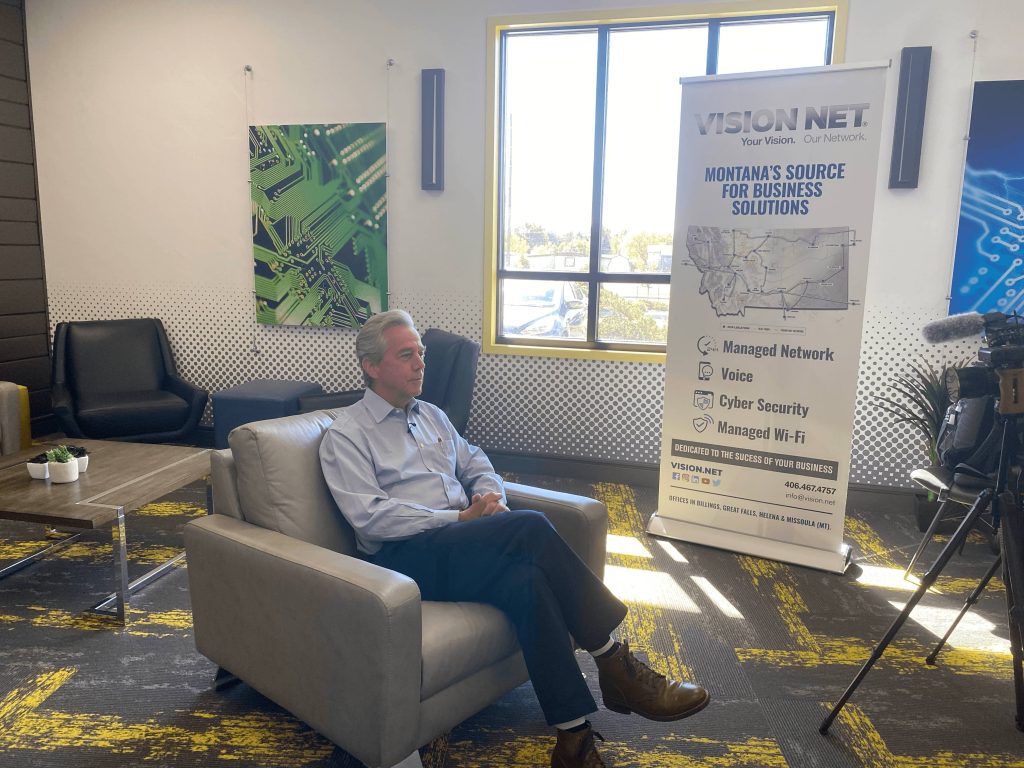
Our CEO Rob Worden recently sat down with KRTV to discuss the future of telecommunications and cybersecurity. This insightful interview provides a window into how Vision Net aims to enable businesses to thrive through transformative tech.
Watch the full interview below with Rob Worden to learn more about how Vision Net can help your enterprise safeguard critical systems, leverage technology, and reach new heights.
ACCELERATING BUSINESS SUCCESS: UNVEILING THE HIDDEN BENEFITS OF VISION NET FIBER INTERNET
In today’s dynamic business environment, Vision Net emerges as a trusted B2B service provider, offering a range of distinctive benefits that set it apart.
1. Seamless Multi-Location Connectivity
Vision Net’s Fiber Infrastructure enables businesses to seamlessly connect their multiple locations, using any protocol, ETS, MPLS, EVPL, or Internet, fostering collaboration and streamlining operations.
Whether your business has remote teams or branch offices spread across different regions, Vision Net’s robust fiber infrastructure ensures reliable and high-bandwidth connectivity.
This unified network experience enhances communication, facilitates data sharing, and simplifies centralized network management, transcending geographical barriers.
How Vision Net Helps: At Vision Net, we specialize in designing custom solutions that enable businesses to connect their various locations effortlessly. With our connectivity services, businesses can achieve efficient inter-office communication, secure data sharing, and centralized network management, irrespective of geographical constraints.
2. Enhanced Cybersecurity
In an era of escalating cyber threats, Vision Net’s Network places a strong emphasis on ensuring the security of businesses’ digital assets.
Leveraging the inherent security benefits of fiber-optic connections, Vision Net implements robust encryption protocols, DDoS protection, advanced firewalls, and comprehensive security measures to protect against cyber threats.
This proactive approach safeguards businesses’ sensitive data and helps maintain data integrity.
How Vision Net Helps: We prioritize the security of your business at Vision Net. Our dedicated cybersecurity team continuously monitors and fortifies our network, keeping it resilient against potential vulnerabilities. By partnering with us, businesses can rest assured that their valuable data is protected by our stringent security measures.
3. Uninterrupted Business Continuity
Vision Net’s Network offers unparalleled reliability, ensuring uninterrupted business continuity, even in challenging circumstances.
With redundant connections and proactive monitoring, Vision Net minimizes downtime, allowing businesses to maintain seamless operations.
This robust connectivity empowers businesses to deliver consistent services, enhance customer satisfaction, and mitigate the impact of unforeseen events.
How Vision Net Helps: We understand the criticality of uninterrupted connectivity for businesses. At Vision Net, our robust network infrastructure, coupled with redundant connections, ensures that your business remains operational, even during unexpected disruptions. Additionally, we can provide comprehensive disaster recovery solutions and backup options to further safeguard your business’s continuity.
4. Dedicated Business Support
At Vision Net, we believe in building strong, long-term partnerships with our clients. We go beyond providing services by offering dedicated business support to address specific needs and challenges.
Our experienced professionals are readily available to offer technical assistance, address concerns promptly, and guide businesses in leveraging the full potential of fiber internet for their operations.
How Vision Net Helps: Our commitment to exceptional customer service sets us apart. We assign dedicated account managers to work closely with businesses, ensuring their connectivity needs are met efficiently. With 24/7 support, proactive network monitoring, and ongoing consultation, we empower businesses to optimize their operations and achieve their goals.
Vision Net’s Network offers unique advantages that empower businesses to thrive in today’s competitive landscape. Through seamless multi-location connectivity, enhanced cybersecurity, dedicated internet access, uninterrupted business continuity, and dedicated business support, Vision Net redefines the B2B telecom services experience. By partnering with Vision Net, businesses can unlock the full potential of fiber internet and gain a competitive edge in their respective industries.
More and more, reliable fast internet access is an essential service. At Vision Net, we understand this need and work to connect small internet providers in the state to the rest of the world. As a ‘middle mile carrier,’ Vision Net’s role is to route internet traffic securely across our network to where it needs to go."
Decades ago, “the internet used to be just a fun thing to have at home, and now it’s a critical service,” Gary Evans. Vision Net’s Operations Manager said. “911 is riding over our network for a good portion of the state. We carry the 911 traffic, one of the things we do behind the scenes. So, if our network goes down, a lot of people couldn't call 911.”
Currently, Montana is one of the worst states for internet connectivity; “there's a lot of dirt between light bulbs in Montana. We’re just one little town with long streets,” said Geoff Feiss, the General Manager of the Montana Telecommunications Association. The association represents locally owned service providers in the state.
Montana is “a big state, not a lot of consumers. It’s very hard to serve. It’s just an expensive place to serve,” Feiss said. The infrastructure bill being considered by the federal government could help Montana’s rural communities secure high speed internet access. “It would provide $42.5 billion for broadband infrastructure investment,” Feiss said.
A report from 2012 completed by the Federal Communications Commission found that 6% of the population still lacks access to fixed broadband service at threshold speeds. In rural areas, nearly 25% of the population lacks access to this service. Feiss and Evans hope they can help bring more access and better connection to people who need it, with fiber being the desired option. “Fiber optics is the Cadillac, the gold standard of broadband technology,” Feiss said. “It’s a reliable medium and it happens to be able to deliver as much bandwidth as you can consume.”
Vision Net remains committed to delivering secure high-speed internet to keep our state’s economy growing and providing businesses with the tools they need to flourish. Watch the special report by KRTV to learn more.
As part of Vision Net's commitment to statewide broadband, we are proud members of the Montana Telecommunications Association. We sat down with General Manager Geoff Feiss to learn about the partnership between Vision Net and MTA.
Tell us about MTA We represent the rural broadband providers in Montana; not the large national providers. We have 11 member companies, and they range from companies with fewer than 1,000 customers to more than 20,000 customers. Our member companies cover about 70% of Montana’s land mass and employ over 1,000 people across the state, with close to $100,000,000 invested annually across the state.
Tell us about the Vision Net/MTA partnership It is a close and wonderful relationship. My member companies are your shareholders and beyond that, I like to brag about Vision Net’s advanced communications infrastructure. Recently, Vision Net hosted congressional staffers to show the Broadband Access management system Vision Net operates. MTA enjoys showing off Vision Net’s NOC, which was a highlight of the congressional staffers’ tour.
Geoff Feiss speaks at the 2021 Share the Vision Conference
What does 5G look like for Montana? For Montana, 5G offers potential, but we need to differentiate the types of speeds we can deploy throughout the state. We mostly deploy mid-band 5G in Montana that propagates very well and provides the coverage needed. We connect the transmitters throughout the state with our fiber network to provide connectivity throughout the state, with a concentration on the urban areas of the state. Rural connectivity remains a priority for MTA.
Has the Vision Net/MTA partnership benefitted Montana communities? A lot! Vision Net is an internet access provider that offers coordination between MTA and Montana communities. In your interview with INDATEL, Mel highlighted the advantages for small rural providers to be a part of the national map. We collaborative and aggregate our services, and Vision Net uses that aggregation to expand and leverage what small companies can do into a larger national footprint.
What are the results from the Vision Net/MTA partnership? I ask Vision Net to help out in the public policy arena, especially for the state’s 911 network. Since Vision Net operates the state’s e911 network, and since I am on the 911 council, I reach out to Vision Net for operational advice for public policy.
What does the future hold for Vision Net and MTA? We exist to help create an environment wherein our member companies can grow and continue to deliver broadband to the communities they serve. We pave the way from an economic and political environment for our member companies to exceed their customer’s expectations. We remove obstacles where we can, so that they can continue to deliver broadband. For example, this year, we passed legislation that allocates $275,000,000 of funding for broadband grants to expand broadband throughout Montana. And since by some measures Montana ranks at the bottom nationally for broadband access, Connect Montana was enacted to provide funding from the American Rescue Plan to improve broadband deployment throughout Montana. MTA strives to lift Montana out of the ‘basement’ and into the middle of the pack for broadband connectivity nationwide. The recent legislation represents one of the most progressive and robust opportunities to expand broadband infrastructure throughout the state.
What additional insights can you offer? Keep up the good work, Vision Net!
Watch Geoff's full video here:
INDAVision: The dynamic team invested in rural and urban fiber
Tell us about INDATEL With the purpose of showcasing statewide networks on a national basis, in 2002, 3 independent networks came together and started INDATEL. Bringing together these networks, the intention was to a promote the value of rural broadband that's become so much more important over the last 2 decades. In fact, next year, INDATEL will celebrate our 20th year! Today, we have 32 member owners with 17 of those being actual equity owners. They are comprised of more than 700 independent local operators across 32 states. That continues to grow our ability to develop broadband in those rural spaces, with the fiber builds and government support that help build and fulfill those opportunities, bringing improved broadband to under and unserved areas.
The mantra of INDATEL from those initial statewide founding networks and individuals to the 32 we have today is about providing value to our member owners, and each of the member owners invest in INDATEL annually. We take those investments and look to co-brand, co-market, and bring awareness and exposure at a national level. Most important are the national contracts that most of the statewide networks couldn’t garner for themselves, such as national government accounts that we’ve begun to fulfill from over 100 locations.
How has the INDATEL/Vision Net partnership benefitted both company’s clients? Today, INDATEL is working our way toward government sales and direct enterprise sales as we continue to grow and build on advanced and diversified models with revenue streams. The value to the member owners has been in initially providing lower cost solutions at a national level and electing those services to stay at local levels. The biggest content these days is known as hyperscale players like Netflix, Google, and national aggregation POPS (Point Of Presence Site) throughout the country. INDATEL connects customers in multiple locations in multiple states throughout the country through our carrier ethernet.
Tell us about the partnership between INDATEL and Vision Net? I'll give you an example that ties directly to Vision Net; at the very first carrier Ethernet type of solution was from Big Sky Montana to Missouri at 10mg circuit tying two medical facilities together. Previously, when you tried to do that on a national basis, there wasn’t a single national player that can put that together. INDATEL, through its family of networks connected those two via Ethernet 10mg service.
With Vision Net in Montana, that fulfilled the need to have a local player to meet INDATEL in Chicago and the aggregation router to our Missouri member. This was the perfect example of a medical organization connecting their facilities that wouldn’t have been possible under one single carrier and that's the beauty of INDATEL; bringing one to many. Bringing one solution by using many players; bringing one contract, one bill, one point connection, and one hand off.
I would categorize INDATEL as the largest national rural broadband aggregator. There's no other company that, at this point, can touch the number of miles of fiber that we have in that space. With over 5,000 miles of fiber, I think it's more like we have over one million on net Internet buildings identified. We work with over 5,000 communities and 19 national aggregation POPS.
What projects have both companies completed together, and what were the results? There are projects or initiatives that bring value to INDATEL; projects that lead into automation efforts and projects that have provided value. Salesforce.com is probably the most recent one where that was the driver of our automation from quote, service, delivery, and building customized software that members of our statewide networks in the local independent operators can take advantage of at a much-reduced price. INDATEL members such as Vision Net bring new opportunities and projects to the forefront, like helping us determine if there is a groundswell that could garner value and something that INDATEL could take forward in the national level.
What is the vision and mission of the Indatel/Vision Net partnership? INDATEL’s history with Vision Net is deep and impressive. I have to single out Corey Jensen; he has been on INDATEL’s board for 12 years and he was President for six years and after a short hiatus, recently returned to the board. In the early days of INDATEL, he was instrumental in building the first aggregation route from Chicago and worked in billing and other elements getting the problems solved and helping INDATEL get off the ground so that in 2013, we could have permanent employees. The commitment that Vision Net provided in those early days and the amount of time and extra time spent on INDATEL from Vision Net is incredible and it really gets to the deep roots of being in the rural space. Knowing Corey personally, his background and mine are very similar in that nature and that's the fabric of INDATEL tat comprises the work and that mindset, that integrity, that level of effort and commitment is inherent in and folks who have spent their time and background in rural spaces.
If I had to sum up in a word, the partnership between INDATEL and Vision Net, I would call it INDAVision. That is how closely we are tied together and that's how closely we are tied into making this model work in the space we are in today.
What do you see for the future of both Indatel and Vision Net? I think goes beyond what we what we will do today, certainly in terms of automation and the type of revenue that we're driving today. As I mentioned, we’re an exclusively wholesale carrier, but looking at ways that we can work with our member owners and independent owners on building fiber at all levels; last mile, middle mile, and long mile. We’re looking at how to drive revenue from actually building fiber or installing fiber in the ground, so more to come on how that may work and what our efforts will materialize into. But we’re looking at additional ways to drive revenue, drive value, drive fortunes, and bring those opportunities to member owners to help them monetize fiber networks.
Yesterday’s copper to today’s fiber: innovation never stops
For over 10,000 years, humans have used copper to conduct heat, sound, and electricity. Copper cables use an electrical volt to transmit information, and for over 100 years, the telecommunications industry relied on copper wiring to bring people and communities together, and help businesses grow.
The first practical use of copper wiring was in the 1820s following the invention of the telegraph system. Since then, any device requiring an electrical or electronic signal used copper to conduct the electricity needed to deliver messages.
As the west, and especially Montana, expanded following various mineral and mining booms, the population grew, and with it, the need for telecommunication services was necessary. As the demand grew, copper provided some of the most significant technological breakthroughs of the 20th Century.
While copper wiring helped support the infrastructure needed for fast and dependable communication, today’s telecommunications industry uses the reliable and fast connection that only fiber can provide. The growth of fiber began in 1961, when Elias Snitzer published a theoretical description of single-mode fibers, with a core small enough to carry light with one waveguide mode, demonstrating a laser directed through thin glass fiber.
As copper wiring continued to be the industry-standard for reliable network connectivity, the practical use for fiber optic became apparent when Bell Laboratories developed and patented the process to mass-produce fiber optic cables, driving down the price and signaling an end to copper’s dominance. Once fiber took off, it supported the rapid growth of the internet, smartphones, and the IoT that have dominated our business landscape.
Vision Net Wholesale team has spent the last 20 years installing fiber optic networks throughout Montana and has been a leader in network transformation throughout the region. With our ongoing fiber training, Vision Net is well-equipped to provide the connectivity your business needs.
Demand for bandwidth doubles roughly every 18 months and, with our increasingly connected world, it shows no signs of slowing. Since the data connection you choose will support your business' growth, it is important that you make the best investment you can. Vision Net’s 100% digital fiber network spans over 5,000 miles from the North Dakota border to western Montana and provides a secure connection to keep your business running. Learn how Vision Net’s robust fiber network is the best choice for your business.
Employee Spotlight: Ken Meyer
This month, we met Ken Meyer, Vision Net's Senior Network Technician/Supervisor in our Billings office. Learn about the technological changes that have guided his career, how networks have changed from copper to fiber-based, and his favorite way to unwind out of the office!
How long have you worked at Vision Net? 18 years!
What 3 words describe Vision Net? Innovative, exciting, teamwork
What is your favorite Vision Net perk? Healthcare
What challenges do you enjoy at Vision Net? Ever-changing technology: once I think I've learned all there is, I really haven't! There is always a new technology or innovation to come along, and I get to learn something new!
Are there any projects you have worked on that you’re proud of? The Tandem Network I've been working on that for over 15 years.
What do you enjoy most about being a part of the Vision Net team? The technology and the teamwork. Everyone in the Wholesale department is great to work with!
What advice do you have for prospective Vision Net candidates? When you join the team, you'll find that there is a lot to learn, so be ready to adapt and go outside of your comfort zone. But you will learn fast, and there is always someone who will help!
What is something people would never guess you do in your role? I do the purchase orders for the Wholesale Department!
With the changes in technology, how has your job changed? Going from a copper-based network to an internet and fiber-based network!
What is the greatest innovation you have seen in your lifetime? The internet!
What do you like to do when you aren’t working? Anything outdoors! I enjoy golfing, hiking, camping, really anything outdoors!
What is your favorite movie? Shawshank Redemption
What is your favorite food? Steak!
How do you define success? I go back to what a former coach told me; his words of advice were that "You'll be successful if you learn from your mistakes!" Be determined, work hard, and you'll be successful.
Employee Spotlight: Brad Federenko
This month, we met Brad Federenko, our wholesale and fiber locator in our Billings office. As a newer employee, he brings with him a diverse background and an eagerness to learn about fiber and wholesale technologies and applications. Learn about what Brad enjoys about his role on the Wholesale team, his favorite foods, and how he defines success!
What is your position at Vision Net and what do you do? I am the Wholesale locator here in Billings. I'm a certified splicer as well.
What made you choose Vision Net? I operated the Billings Ice Rink for years and wanted to change careers. I knew a lot of people from Vision Net and when I saw the opportunity, I applied!
What is your favorite Vision Net perk? The job itself! Since I'm the locator, I get to do something different. I'm not stuck in the office, I'm always learning, and I get a company truck!
What is your favorite thing you have learned at Vision Net? Fiber optics
What challenges do you enjoy at Vision Net? Learning everything from scratch, especially fiber splicing. I'm always learning, and I enjoy that aspect of my job!
What advice do you have for prospective Vision Net candidates? Come in with an open mind! It's a great company, great people, and everyone is willing to help. There are no dumb questions, and everyone is very welcoming!
What is something people would never guess you do in your role? I enjoyed the hands-on nature of fiber training and seeing the start to finish of installing fiber networks
What do you like to do when you aren’t working? Golf. I'm getting back into golfing after taking a break for a few years, and I really enjoy getting back into it!
What is your favorite food? Anything I can cook on the grill; be it ribs, chicken, steak, anything!
How do you define success? Being happy, doing a good job, enjoying time off, and enjoying life!
See the full video of Brad's interview!
Weighing the Advantages of 5G: What’s in it for rural states?
A friend reached out to me recently asking about 5G and what it could mean for his business. His question was timely, and it’s a topic I’ve been thinking about quite a bit lately. You can’t turn on the TV, scan social media or open a newspaper or magazine without facing a litany of ads touting 5G as the next best thing.
But is 5G all it’s cracked up to be? And if it is, what does it mean for those of us living and working in a rural state like Montana?
Let’s start with the basics. 5G mobile network technology is the next iteration of wireless connectivity, designed to deliver faster and more reliable service. Notice the word mobile. Like its predecessor 4G, 5G is the connection between a tower and your device, be it a cell phone, smartwatch, or tablet. Proximity to that tower is critical. The best estimates suggest that you need to be within 1,500 feet of a tower to fully reap the rewards. The best scenario—and the one touted most often—is that 5G promises a futuristic landscape of autonomous cars, enhanced machine-to-machine communication, and manufacturing plants run entirely by AI-controlled robots. If it all feels a little bit like Star Trek meets the Jetsons, that’s because it is.
Building out a 5G network and the many towers required to support it won’t be cheap. Large mobile wireless carriers will need to ask themselves if it makes financial sense to invest in this infrastructure in less densely populated areas where usage will be low. More specifically, how long will it take to earn back that investment and begin reaping a profit? It doesn’t take an MBA to realize that for many of these companies, the better investment will be in larger, more densely- populated urban areas.
If this sounds like bad news, let me offer some good news.
The Federal Communications Commission (FCC), through several funding mechanisms, is funneling billions of dollars into shoring up broadband services in rural America. This means that high-speed broadband fiber will soon be accessible to large swaths of rural areas. For many Montanans, this presents a significant improvement over what they’ve been relying on, which is often spotty connectivity and slower speeds. Plus, fiber is ideal in rural settings because the signal doesn’t degrade as it moves away from its source. In other words, there’s no need to be close to a cell tower.
This strengthens the case for fiber in rural settings. Vision Net has already made key fiber investments in Helena and Billings to address exactly these issues, providing a fast and reliable connection for businesses and schools in the area.
This isn’t to say 5G won’t eventually arrive in Montana, but it does seem likely that rural states such as ours may be a bit further down the receiving line. And when it does arrive, you can count on the urban areas of Montana getting 5G well before our rural communities.
In all reality, a mix of fiber and 5G wireless-based broadband will be available across our state for all to utilize. For example, a bank would rely on fiber to run its operating and business processing systems internally, while client-facing services that use apps and websites might leverage 5G to provide a rich customer experience.
So, how will you position your business for this upcoming revolution?
Whether it’s fiber, 5G, or both, my advice is to think through how your business can monetize these bandwidth and connectivity improvements and how best to position your firm to be ready for them when they arrive. In my friend’s case, warehouse automation may provide a much-needed solution to his ongoing challenge to fill empty factory positions.
Another suggestion is to observe how others in your industry are already leveraging broadband and begin formulating your own plan from there. Farmers and ranchers across Montana, for example, may want to look at how drones and other broadband technologies are positively impacting the ag industry, with better monitoring systems for land, livestock, and irrigation that deliver improved efficiencies and cost savings.
And you may want to ponder this question: What are some fiber-backed internal processes that could be implemented to support new technology opportunities when they arrive?
Thomas Edison said “Good fortune is what happens when opportunity meets with planning.” I think it’s fair to say opportunity abounds in the telecom space. Planning for both the short term and long term will be key to meeting this opportunity head-on.